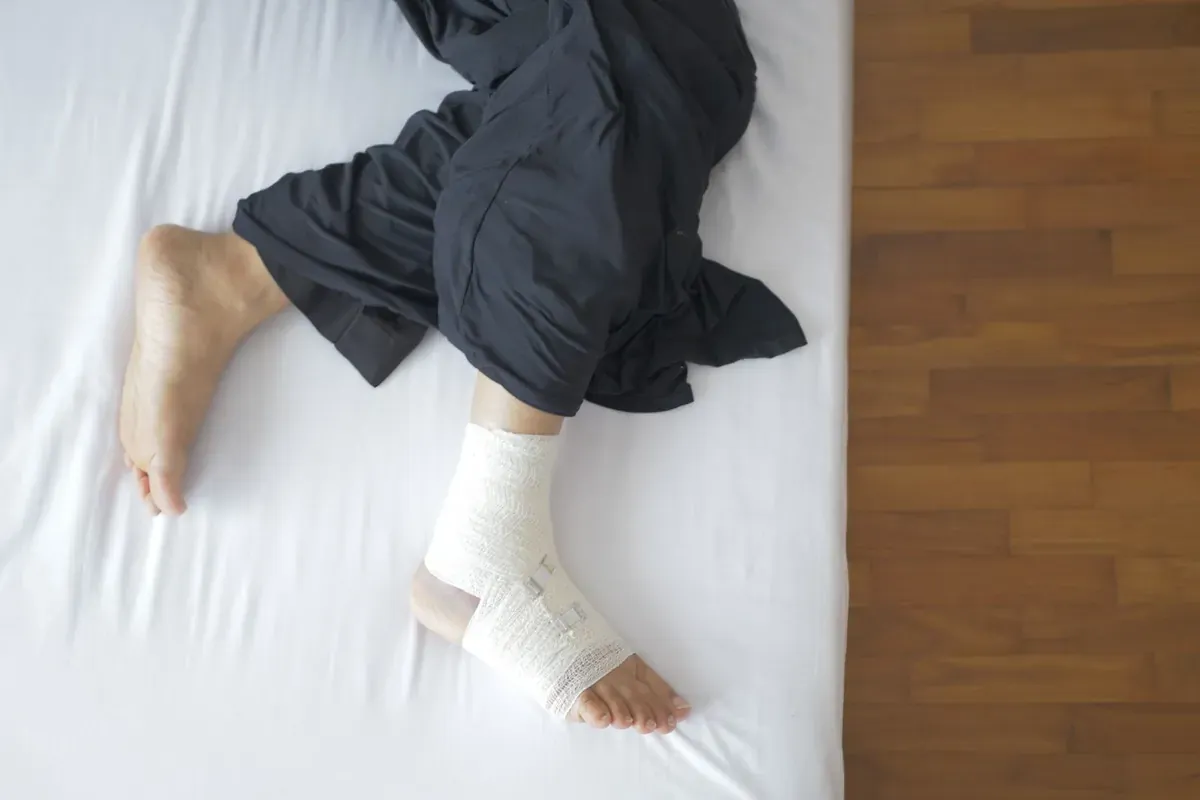
Japan is a walking country — long days, station stairs, uneven temple paths — and twisted ankles are one of the more common ways a trip goes wrong. Most sprains are treated with rest, ice, compression, elevation and time.
Some aren't sprains. If you can't put weight on it, if there's an obvious deformity, or if the pain is severe and localized over bone, you need an X-ray, and no video consultation can substitute for one. This guide is about telling those apart honestly.
First aid in the first 48 hours
- Stop. Continuing on a fresh sprain is what turns two days of trouble into two weeks.
- Ice, wrapped rather than applied directly, for short spells rather than continuously. Convenience stores sell instant cold packs.
- Compress with an elastic bandage — firm, not tight enough to cause tingling or colour change.
- Elevate above heart level when you're sitting or lying down.
- Use over-the-counter pain relief if you need it; Japanese drugstores also sell adhesive analgesic patches, which are ubiquitous here.
Signs you need an X-ray
- You can't take more than a few steps on it, either at the time or afterward.
- There's tenderness directly over bone rather than over soft tissue.
- The joint looks misshapen, or the limb doesn't sit the way it should.
- Severe swelling arriving very quickly.
- Numbness, pins and needles, or a limb that looks pale or dusky below the injury.
- The pain is not improving at all after a couple of days of proper rest.
For any of these, in-person care is the answer. An orthopedic clinic (整形外科, seikeigeka) is the department that handles bones and joints in Japan, and larger hospitals have imaging on site. Our guide to your options when you get sick in Japan covers how to choose between a clinic and a hospital.
What online care can't do
It's worth being blunt about this, because injuries are where telemedicine's limits are sharpest. A video consultation cannot X-ray a bone, put in stitches, reduce a dislocation, apply a cast, give a tetanus shot, or drain a wound. If you need any of those, going in person isn't the slower option — it's the only one.
Cuts follow the same logic: a wound that gapes open, won't stop bleeding with firm pressure, is deep, is on the face, or was caused by something dirty or by an animal or human bite needs in-person assessment, not a photo.
What it can do
For a minor injury that doesn't have any of those features, a video consultation with an English-speaking, Japan-licensed physician can assess your symptoms, advise on management, discuss pain relief and prescribe where appropriate, and tell you plainly whether you need imaging — which is often the actual question you want answered.
It can also produce the paperwork. An English medical certificate and an itemized receipt are issued with every consultation, which is what a travel insurer will ask for if an injury changes your plans. Consultations run 9:00–18:00 JST, Monday to Saturday, with booking open at any hour.
Getting around Japan on a bad ankle
Japan is a wonderful country to travel in and a hard one to do on crutches. Stations are large, transfers involve stairs, and the shortest route between two platforms is frequently not the step-free one. Planning around that is the difference between a slow week and a ruined one.
- Most major stations have elevators, but they can be at the far end of a platform. Look for the elevator symbol on station maps before you set off, not once you're inside.
- Station staff will help. Asking at the gate is normal and they are used to arranging assistance.
- Taxis are expensive but sometimes the right answer; on a bad day the cost is less than the setback of walking on it.
- Reserved seats on shinkansen and limited express trains are worth the surcharge when standing is painful.
- Rethink the itinerary honestly. Temples, castles and shrines involve gravel, steps and long approaches.
Elastic bandages, patches and what pharmacies stock
Japanese drugstores stock elastic bandages, supports for ankles, knees and wrists, instant cold packs, and adhesive analgesic patches — the last of these are close to a national institution and are sold everywhere. A pharmacist can point you to the right shelf if you show them where it hurts.
None of this substitutes for imaging when imaging is indicated. A support does not tell you whether the bone is intact; it makes an intact one more comfortable.
Documentation, if it changes your trip
An injury that costs you a booking, a tour, or the ability to fly as planned usually becomes a paperwork problem too. An English medical certificate and an itemized receipt are issued with every consultation, and that pair is generally what an airline or an insurer asks for.
How do I know if it's broken or sprained?
You often can't tell without an X-ray, which is why the practical test is different: inability to bear weight, tenderness over bone, deformity, or rapid severe swelling all mean get imaged rather than wait.
Can a doctor order an X-ray for me online?
A video consultation can tell you whether imaging is warranted and point you to appropriate in-person care, but the X-ray itself has to be done at a facility that has one.
Where do I go for a bone or joint injury in Japan?
An orthopedic clinic (整形外科) handles bones and joints. For a severe injury, a hospital emergency department; for anything with deformity, numbness or a major fall, call 119.
Can I get documentation for my travel insurance?
Yes — an English medical certificate and itemized receipt are part of every consultation. See our guide to claiming travel insurance in Japan.